Chitligsan skincare products, and the raw material itself.
We formulate our products with Chitligsan, a vegan chitosan derivative made from Sahara soil, and supply the same raw material to brands for their own formulations. Online sales are paused: we are talking to distributors, brands and raw material buyers.
Online sales are currently paused. Get in touch for partnerships and wholesale.
01Origin
Not from shells, from sand.
Chitosan is a natural biopolymer, studied for decades and valued in skincare for its moisture-binding and protective effects. It is conventionally extracted from shrimp and crab shells. Chitligsan is a derivative of that structure, produced from Sahara Desert sand: vegan, free of shellfish, and made by a patented production method.
01.1
Sahara soil
The raw material comes from fossil-origin organic components of Sahara soil (chitin, cellulose, lignin) and its minerals. It depends on no living source.
01.2
Natural, zero-waste production
Natural bacterial and fungal processes replace the strong acids and bases. The production methodology is patented.
01.3
Chitligsan
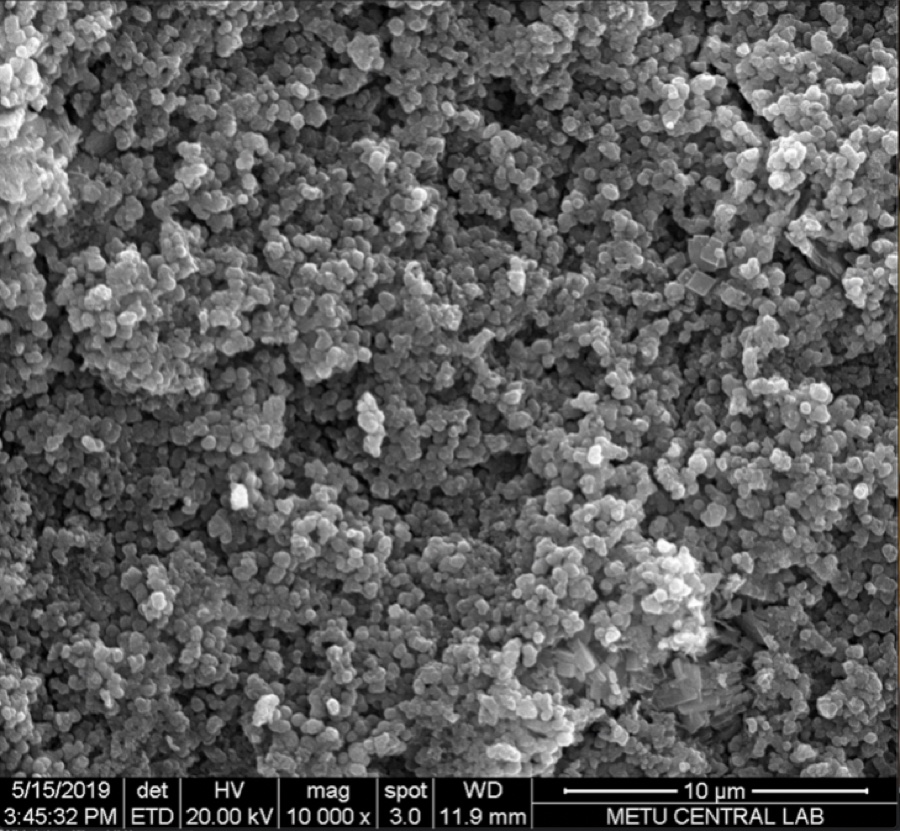
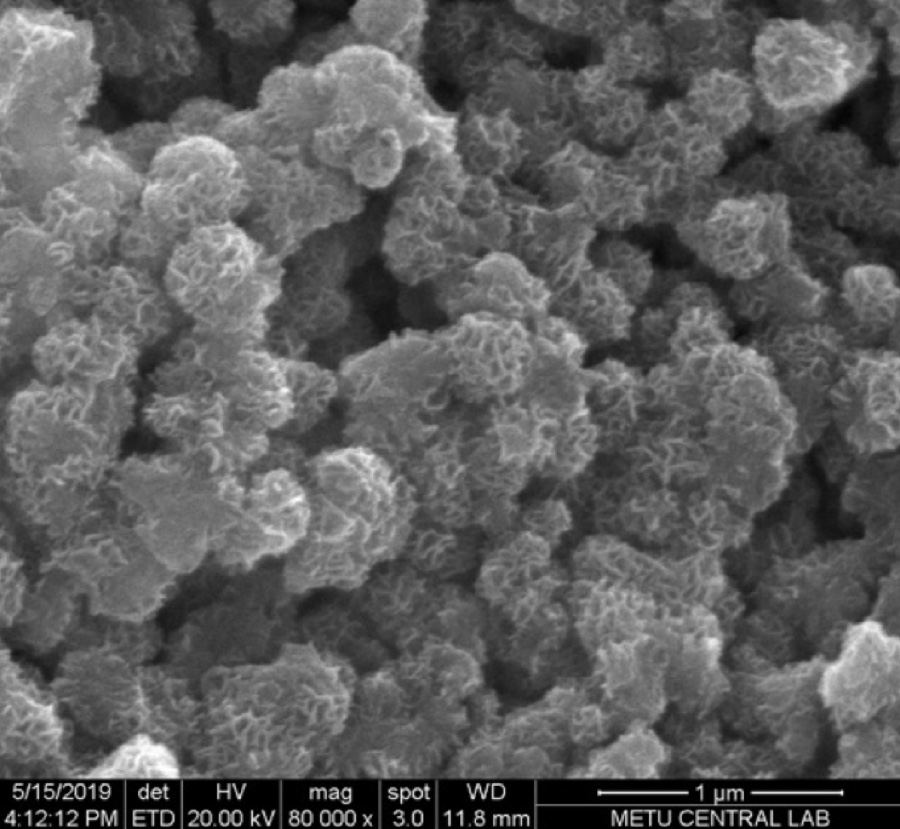
A chitosan derivative: a porous structure at 1 µm under SEM and ~90 nm particles in nanosuspension, rich in trace elements and minerals.
01.4
The science of chitosan
Chitosan’s effects have been studied in more than 60,000 papers on PubMed, 3,580 of them on skin and 5,016 on wound healing. Chitligsan is a derivative of that structure.
Electron microscope image
Chitligsan under the electron microscope (SEM): 10,000× on the left, 80,000× on the right. Image: Kumdan archive · METU Central Laboratory, 2019
Conventional chitosanChitligsan
SourceShrimp and crab shellsSahara Desert soil
Shellfish allergenPresent; traces remain after deproteinisationNone; proteins dissolved over geological time
VeganNoYes
OdourCharacteristic fishy odourNone
ProductionDemineralisation, deproteinisation, deacetylation with strong acids and basesNatural bacterial and fungal processes; zero waste
SupplyTied to the fishing industry; volatile pricingUnlimited raw material; no living source
Molecular structureA larger, high-molecular-weight polymer that mostly stays on the surfacePorous and smaller: 1 µm pores, ~90 nm particles; penetration rises as size falls
Trace elementsNoneFe, Si, Ca, Zn, Mg, Na, S and more
Conventional chitosan
A larger, high-molecular-weight polymer: it mostly stays on the surface.
Chitligsan
Porous and smaller, ~90 nm particles: it travels between the surface cells.
Schematic; not to scale.
02Trace elements and minerals
The elements the sand carries.
Chitligsan combines chitosan’s biopolymer structure with trace elements and minerals from Sahara soil. Tap an element for details.
(C₆H₁₁NO₄)ₙ
The carrier: Chitligsan
The chitosan chain (C₆H₁₁NO₄)ₙ carries the elements and the formula’s actives into deeper layers of the skin.
Confirmed by XRF/FTIR and peer-reviewed analysisKumdan raw-material data
Mineral phases identified by XRD
Calcite42.8%
Hydrotalcite40.3%
Clinopyroxene15.6%
Ilmenite1.3%
Source: RSC Advances, 2026
Heavy metal analysisLead, cadmium, arsenic and mercury were not detected. The analysis report is shared on request.
Does hydrotalcite contain aluminium?
It does: hydrotalcite is a magnesium-aluminium mineral. This is not the aluminium salt used in antiperspirants, though. It is structural aluminium bound inside a mineral lattice, the same form used as a pharmaceutical antacid.
03Effect
The six things skin complains about most.
Each one relates to a property studied for chitosan in general, ordered from the most common complaint down. Chitligsan is a derivative of that structure.
The chitosan derivative used in Kumdan appears in the literature as Chitligsan. Teams at Hacettepe, Bilkent and Atatürk universities measured three separate questions: what it does to bacteria in the lab, what happens on living tissue, and whether sensitive tissue tolerates it. Each study’s question, figure and method is below.
04.1In vitroRSC Advances · 2026Hacettepe University · Bilkent University
QuestionDoes it harm bacteria without harming skin cells?
It does not. Growth of all three pathogens was suppressed while fibroblast viability stayed above 90%.
The three organisms tested are those used in cosmetic preservative efficacy testing.
The sample prepared in deionised water reached a 20 mm zone against S. aureus.
In the MTT assay viability stayed above 90% at all four concentrations, with no dose-dependent toxicity.
Method: agar well diffusion and the L929 fibroblast line. In the same study’s scratch assay, migration was slower than in the untreated control; this is not a finding of accelerated healing.
Sahara Desert sand “Chitligsan”: characterisation and assessment of antibacterial activity and cytotoxicity
Inhibition zone diameter in agar well diffusion (mm) — higher is better
S. aureus1612
E. coli1512
P. aeruginosa150
ChitligsanControl (citric acid)
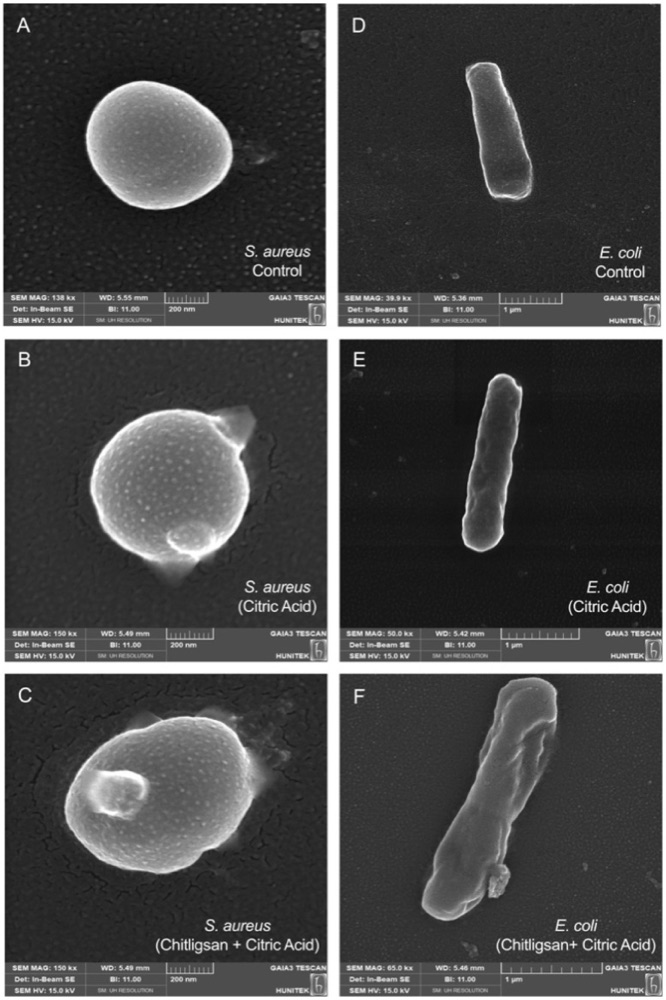
Electron microscope image
S. aureus (left) and E. coli (right) under the electron microscope. Top row: untreated control; middle: citric acid; bottom: Chitligsan with citric acid, where the cell surface has collapsed and lost its integrity. Image: Ertunc et al., RSC Advances 2026, CC BY 3.0
04.2In vivo · 48 ratsCutaneous and Ocular Toxicology · 2025Atatürk University
QuestionWhat does it do on living tissue, compared with an established product?
By day 21 the wound area was smaller than with the antibiotic ointment and than the control.
Histopathology reported better epithelial regeneration, dense collagenisation and minimal inflammation.
The nanosuspension measured 89.6 nm with a zeta potential of −26.1 mV.
The difference was statistically significant (p < 0.05).
Method: a full-thickness wound model in 48 rats over 21 days. An animal model, not a cosmetic product claim.
Comparative evaluation of chitligsan nanosuspension gel and spray for enhancing full-thickness wound healing in a rat model
These studies were carried out on the raw material (Chitligsan) in laboratory and animal models; they are not clinical results for Kumdan products. Cosmetic products are not intended to treat disease.
05Products
Five products built on Chitligsan.
Chitosan sits at the centre of every formula, joined by only a handful of proven actives. The essential oils are chosen by a NAHA-certified Level 2 aromatherapist for what they do, not for how they smell. The products are not currently sold online.
Face Cream
Chitosan+Niacinamide+Vitamin B5
For every skin type: moisture balance, barrier support and a more even tone.
Chitosan binds moisture and carries the actives, niacinamide evens the look of spots and pores, and vitamin B5 hydrates and soothes.
Melaleuca alternifolia · Salvia officinalis · Lavandula angustifolia